
Coon Rapids, MN · Garage Door Service
What That Noise From Your Garage Door Is Actually Telling You
Coon Rapids homes built between 1957 and 2007 carry different hardware and different noise patterns. Here's how to tell a cold-weather squeal from a real problem.
- Repairs & new doors
- Springs & openers
- Serving 7 nearby communities
What Is Going On
Most garage doors in Coon Rapids were installed somewhere between 1957 and 2007, with a lot of that stock landing in the 1980s and 90s build boom that shaped 48 named areas of this service territory. That spread matters because a door's age tells you what kind of noise to expect. A squeal on a door from the 80s is usually dry rollers or a hinge that's never seen a drop of lubricant since the house was framed. A bang or a thud on a newer door, from the 2000s wave of construction, is more often a loose track bolt or an opener gear that's starting to strip, since those doors came with lighter-gauge hardware than the older ones.
The sound itself is diagnostic. A grinding noise when the door starts to move points at the opener's drive gear. A rhythmic clunk once per rotation points at a roller with a flat spot. A sharp metallic pop, especially in winter, is almost always a spring under load finding a weak point in a bracket or a worn cable drum. None of these sounds mean the same thing twice, which is why guessing from a quick video call rarely helps - we want to hear it in person before we say what's wrong.
What to Look At First
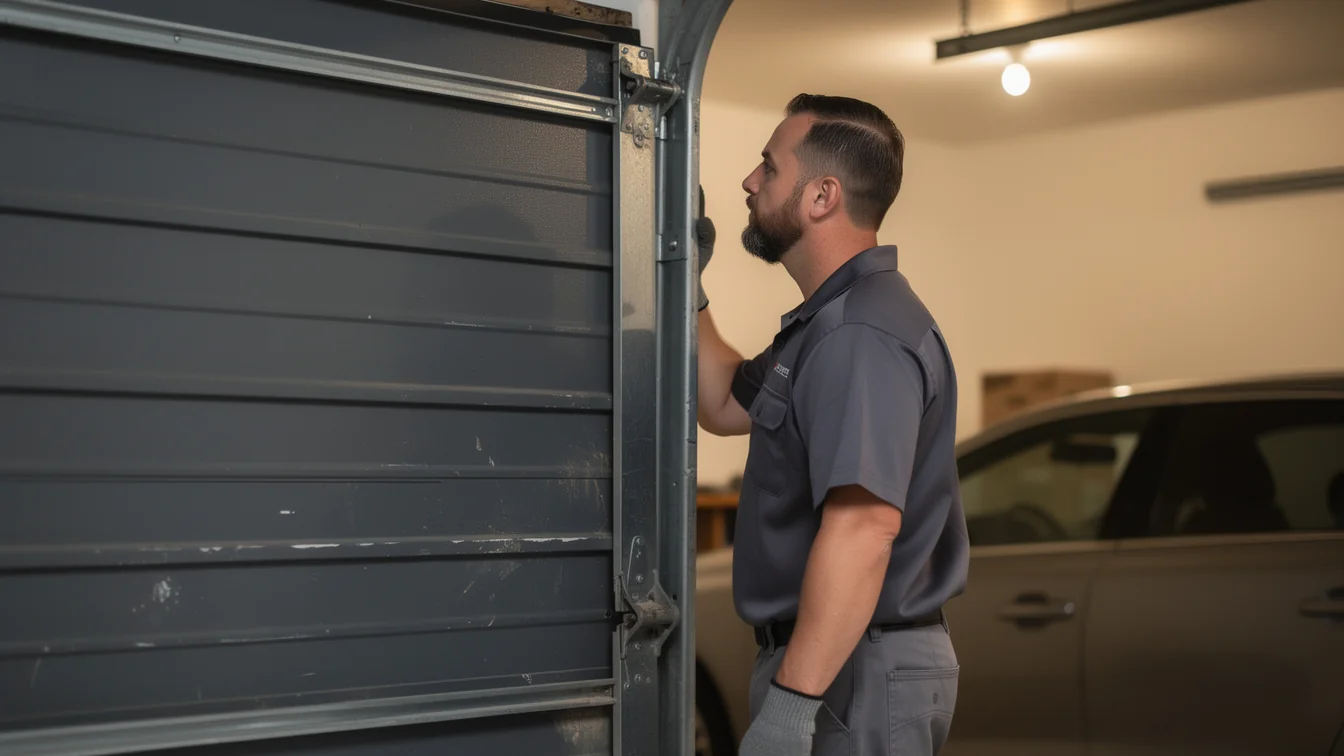
Before you call anyone, open and close the door a few times and watch the tracks, not just listen. On a house from the 1982 median build year, the tracks are original more often than not, and loose track brackets are the single most common source of a rattle that sounds worse than it is. Check the lag screws where the track meets the frame - if you can wiggle the bracket by hand, that's your rattle, not your spring.
Next, look at the rollers themselves. Nylon rollers from a 90s-era install start to crack and flat-spot after enough winters of expansion and contraction, and a flat-spotted roller makes a noise that gets louder as the door speeds up partway through its travel. Steel rollers on older torsion setups wear a groove and start to squeal instead.
One honest limitation here: a noise that only happens below a certain temperature is hard to fully diagnose standing in a warm garage. If it's quiet when we show up and loud again that night, tell us the specific temperature range - it narrows things down more than you'd think.
How Local Conditions Play In
Coon Rapids sits in a severe cold climate band, and that's not a small detail for a garage door. Steel contracts in cold air, and a door that's a quarter-inch out of adjustment in July can bind hard enough to groan in January. Grease that was fine in summer thickens up in a cold garage and stops doing its job, which turns a silent roller into a squeaky one the first week temperatures drop.
Springs feel this too. A torsion spring under tension flexes slightly with every open and close, and cold steel is less forgiving of that flex than warm steel. That's part of why late fall and early winter are when this phone rings most for noise complaints - it's not that anything broke overnight, it's that the cold finally exposed wear that was already there.
If your house falls into the 1980s-90s stock that makes up most of this area, the hardware doing that flexing has likely been through 30-plus winters of exactly this cycle. That's a long run for springs and cable that were never meant to last forever.
When Waiting Is Fine
Not every noise needs a same-week call. A light squeak that shows up only in the first cold snap and settles down once you've run the door a dozen times is usually just stiff lubricant working itself loose - a can of garage door lubricant on the rollers and hinges often fixes it without a truck coming out at all.
A noise that's been there for months, stays the same, and doesn't get louder is also lower priority. Wear that's stable isn't wear that's about to fail. What should move you off the couch is a noise that's new, getting louder week to week, or that shows up with a visible symptom - a cable that looks frayed, a bracket you can move with two fingers, a door that jerks instead of gliding. Those are the combinations where waiting costs you a spring that lets go instead of a roller that just needs grease.
Frequently asked questions
Why does my garage door only make noise in the winter?
Cold steel contracts and grease thickens, so hardware that's slightly worn or under-lubricated in summer often goes quiet until the first real cold snap exposes it. Coon Rapids' severe cold band means this cycle repeats every year, and it tends to find the weakest point in aging rollers, hinges, or spring brackets first.
My house was built in the 1980s - should I expect more noise than a newer house?
Often yes. A lot of Coon Rapids housing stock dates to the 1980s and 90s, and hardware from that era has usually gone through three decades of seasonal temperature swings. Original rollers and cable are more likely to be worn than hardware in a house built closer to 2007.
Is a loud bang from the garage always a broken spring?
Not always, but a sharp metallic pop, especially in cold weather, is a common sign of a torsion spring reaching a weak point. It can also be a bracket letting go or a cable drum shifting. Either way, stop using the door and have it looked at - don't try to force it open.
Related garage door services in Coon Rapids
More garage door guides
Book garage door service in Coon Rapids
Call now or request a quote - tell us what the door is doing and where you are.